Showing posts with label social studies. Show all posts

Sunday, November 19, 2017

The Silk Road

Written by Sam L.

Today, many people exchange things through mail, texts, and talking on a phone. But things weren’t always that way. For hundreds of years, between about the year 500 and the 1500’s, the Silk Road was the main trading route of Europe, Asia, India, and many other countries and major cities.

Sketch by Finn
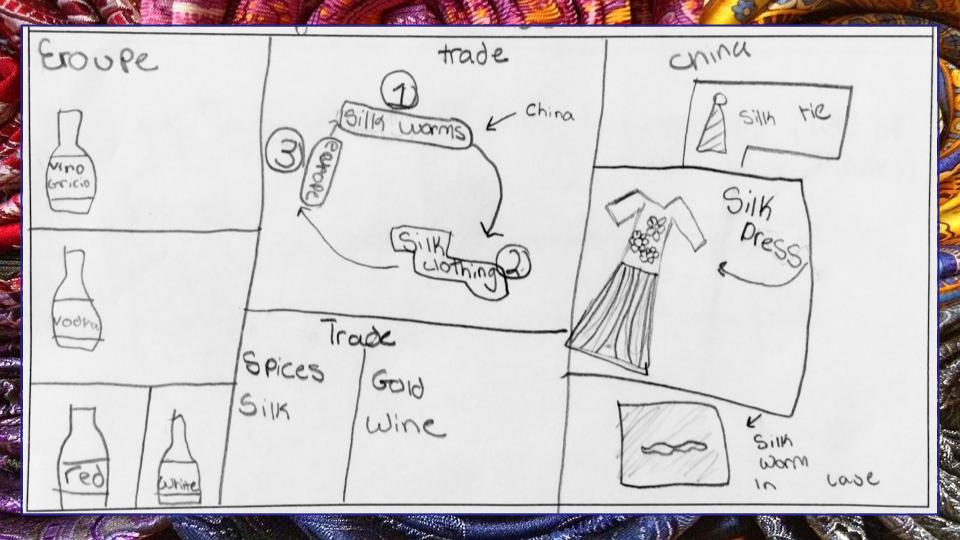
Many goods were traded throughout the Silk Road. Some of the main ones being silk, spices, gold, tea, salt, wines and furs, and ceramics.

Sketch by Marra
Sketch by Iliana
Sketch by Taya

Learning about the Silk Road is important because it teaches us about our history and how cultures were connected in the ancient world.

It also taught us about where most of the trade went along in Asia and Europe. Most of the trade routes passed through Constantinople which for most of the time the Silk Road existed was controlled by the Byzantine empire. Constantinople was later conquered by the Ottoman Empire in 1453.

Sketch by Gabi

Going along the Silk Road the entire way would be a very hard and laborious challenge. The Silk Road was mainly made up out of different parts and sections of smaller trade routes that eventually came together and formed the Silk Road.

Sketch by Krish

The way the Silk Road worked is that one merchant or seller would take their product along the Silk Road and drop it off at a city on the Silk Road. Let’s say it was a shipment of silk. The silk could be carried from China to India and the merchant would sell it there. Then another merchant would take that silk and perhaps transfer it to Persia and from there to Arabia. From Arabia to Constantinople, and from Constantinople to cities in Europe.

Sketch by Saoirse

So items didn’t necessarily have to go all the way along the Silk Road with the same merchant. It would connect through a series of different merchants and trading routes.

By learning about the Silk Road, we learned about the history of contact and trade between many different people, including the exchange of ideas, technology, and germs.

As Palmer said, "I have learned many things, including world history, how you make silk, geography, and what countries made which things. The learning goal was to teach us about what life was like and what happened hundreds of years ago." 


Sketch by Abby

In a future blog post, we will explore what happened at Constantinople in the year 1453 and how that affected trade along the Silk Road and led to a "discovery" that changed the history of the whole world...

Sunday, November 5, 2017

Field Trip to the Mashantucket Pequot Museum

Written by Bryan L.

This activity was a field trip to the Mashantucket Pequot Museum. It was very fun, and it had a real-life scale model of a Native American village from around 1500.  In social studies, we were learning about all different tribes and who were the first people to come to the new world. We are also learning about how the Native Americans of this area lived before Europeans came.

There were also tons of artifacts. There was another part when you take an escalader down to a different floor about the Ice Age, and all around you there was ice and water running down the ice.

Here is a slideshow with pictures from the exhibit of the Pequot village and captions written by us!


Here are some quotes from students about the trip:
  • "I thought it was awesome!" - Josh
  • “It was so fun because we learned how to create tools and go on the tower. But we had lunch way too late, my stomach was growling.” - Seamus
  • “The things that I liked about the field trip were the giant elevator that brought us up high. I also liked the village, it taught me a lot of things and made me feel like I was really in a Pequot village.” - Palmer
  • “Why I think we went on the field trip is to learn how different and difficult it was back then compared to now. Because now we have phones, cars, computers, all this mechanical stuff plus all sorts of robots and parks etc.” - Maxwell
  • “It is important to learn about them because you can compare how they lived and how we live.” - Patrick


Saturday, October 28, 2017

Peasants and Monarch Simulation

Written by Alexander H. and Blake M.

Nowadays, everyone wants us to “treat others the way we want to be treated,” which is what we should be doing, but it wasn’t always like that. In Europe in the 1500’s, it was a very unfair and dirty life for the peasants while the King or Queen, the nobles, and the church had a lot of things.

This activity was about experiencing how unfair life was like in Europe in the 1500’s.


By doing this activity, it helped us understand what the peasants' life was like in the 1500’s. We learned that it was very, very unfair. Not all of us liked this activity, in fact, most of us didn’t. Everyone who was a peasant was very mad that the “queen” and the “noble” got to have fun and do whatever they wanted.
  • “It was terrible activity. It was the worst activity in the world, and I never want to do it AGAIN!” - Alex M.
  • “I hated it.” - Iliana
  • “I liked nothing about this activity because everything was unfair. I was very happy when it was over.” - Aaron
  • “I know that I didn’t like this activity because it was super unfair for the peasants, but I’m sure the 'queen' loved it because she was spoiled." - Sophia

In most students' opinion, it was not fun but other people's opinion was different because their experiences were different.

  • “I think that being a peasant was horrible, even though I was just a peasant for five minutes. When I was a knight, it was much more luxurious. I got to eat candy and play videogames, but I still respected the peasants.” - Leo
  • “It was fun because I got to play on the iPads, eat candy, and listen to music.” - Bailey (a noble)
So even though many people thought this activity was unfair, the peasants and monarch activity was a powerful way to learn about what life was like in Europe in the 1500’s.

Gabi called the activity, "Terrible. Unfair. Unforgiving." But she went on to say, “I learned how bad life was back then if you were a peasant.”